
Why NiTi as the raw material of the bristles
- NiTi has the best mechanical property for debridement of titanium-based dental implant surfaces.
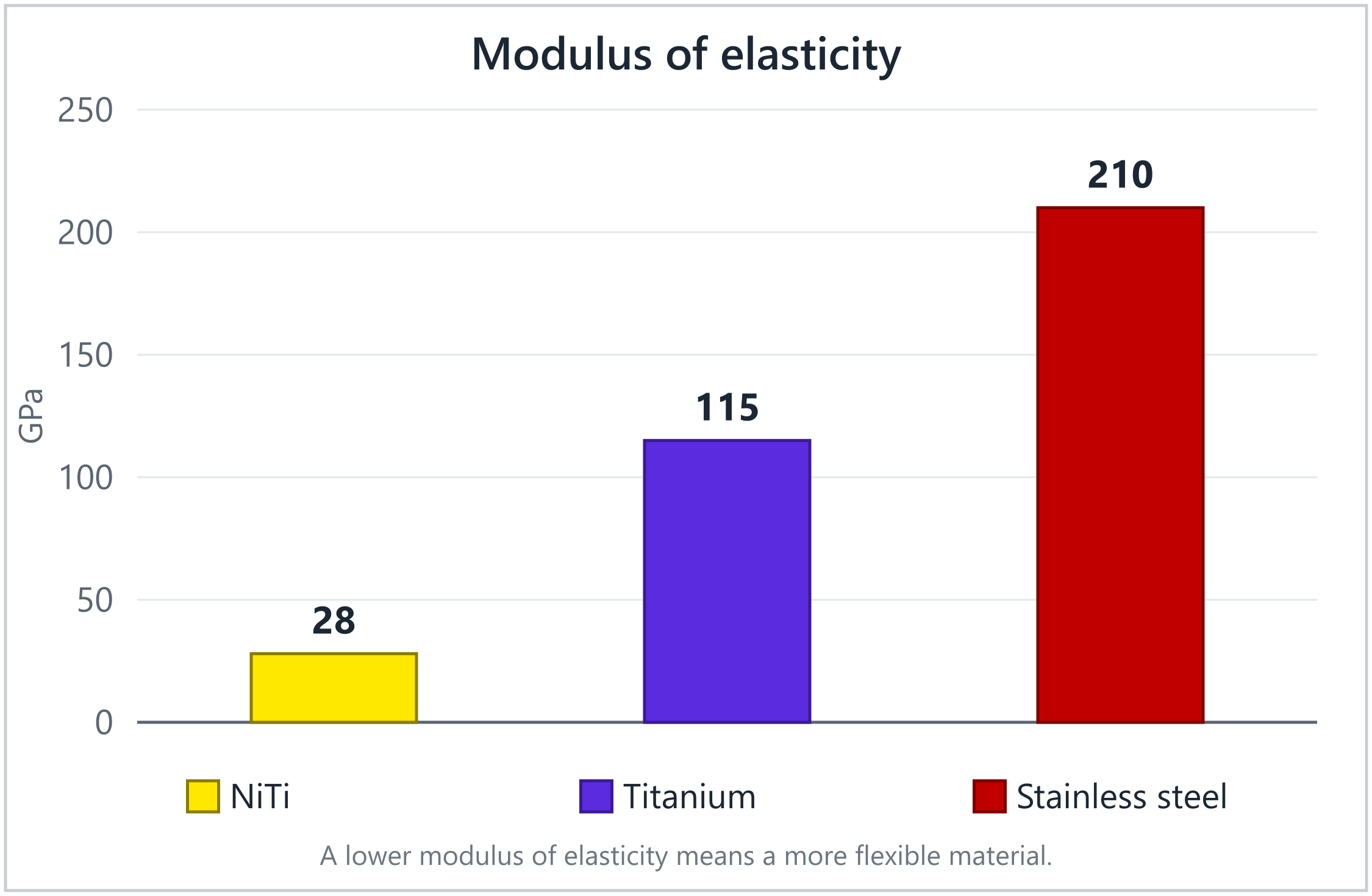
- NiTi is 3 times more flexible than titanium.
- NiTi has similar hardness to titanium.
- NiTi can debride the implant surface with less damage.
Comparison of mechanical properties
Titanium, NiTi and stainless steel.
| Property | Titanium | NiTi | Stainless steel |
|---|---|---|---|
| Modulus of elasticity | 115 | 28–41 | 210 |
| Hardness (Vickers) | 200–340 | 303–362 | 600–610 |
We can say that the NiTi bristle could be more effective than the titanium bristle for the debridement of titanium-based dental implant surfaces.
Stainless steel is a very hard material and it has less flexibility compared with titanium. So stainless steel would not be a suitable material for the debridement brush of a dental implant surface.
Understanding the modulus of elasticity
The modulus of elasticity measures how stiff a material is. Diamond sits near the top of the scale at about 1,000 GPa and rubber near the bottom. A smaller modulus means a more flexible material.
Titanium particles what the measurements show
Every instrument that touches an implant surface releases some titanium. The clinically useful question is not whether particles are released, but how much, and compared with what.
An independent group at the Sir John Walsh Research Institute, University of Otago, measured this directly. One hundred and forty moderately roughened titanium discs were divided into seven groups, instrumented, and the rinsing solution analysed by inductively coupled plasma mass spectrometry. The rotary brush used in that study was the NiTi Brush OMEGA, named in the paper.1
| Method | Titanium released | Mean particle size |
|---|---|---|
| Ultrasonic scaling, metal tip (low power) | 34.00 ± 12.54 µg | 0.89–1.25 µm |
| Ultrasonic scaling, metal tip (medium power) | 34.44 ± 6.08 µg | 0.89–1.25 µm |
| NiTi Brush OMEGA | 6.45 ± 2.03 µg | 1.05 ± 0.11 µm |
| Ultrasonic scaling, PEEK tip | ≈0.89 ± 0.14 µg | 0.89 ± 0.27 µm |
| Air-polishing, erythritol powder | 0.67 ± 0.12 µg | — |
Ultrasonic scaling with a metal tip — the most widely used mechanical method — released about five times more titanium than the NiTi Brush, and that difference was statistically significant. Air-polishing and the PEEK tip released less than the brush, but they are also the gentler options, and the authors note that these methods are chosen for different clinical purposes.
What this does and does not mean
We do not claim the NiTi Brush releases no titanium. The measurement above says it does, at roughly a fifth of the mass produced by metal-tip ultrasonic scaling, with particles of comparable size.
Whether those particles matter clinically is still unsettled. A 2025 systematic review of fourteen studies on implantoplasty found titanium particles from 100 nm to 54 µm in peri-implant tissue, at higher levels around diseased implants — but human studies did not confirm a direct relationship between particles and peri-implantitis or marginal bone loss, and the certainty of the evidence was rated low.2 The question is open, and we would rather state that plainly than claim more than the data supports.
Why the difference is plausible: Ni-Ti bristles are roughly four times more flexible than titanium at comparable hardness, so the bristle bends into the thread and wipes the contaminated layer away rather than machining the implant body down. That is a different mechanical action from implantoplasty, which deliberately removes implant material with a bur.
References
- Kao A, Tawse-Smith A, Ma S, Duncan WJ, Reid M, Atieh MA. Quantity and size of titanium particles released from different mechanical decontamination procedures on titanium discs: an in vitro study. Dentistry Journal 2024;12(5):123. DOI: 10.3390/dj12050123 — open access
- Rodríguez Alvarez MB, Padullés-Roig E, Cabanes-Gumbau G, Callejas-Cano JA, Gil J. Release of titanium particles after implantoplasty in the treatment of peri-implantitis: local and systemic implications — an integrative systematic review. Journal of Clinical Medicine 2025;14:8661. DOI: 10.3390/jcm14248661 — open access
HANS Korea is not the publisher of either work, holds no copyright in them and has no commercial relationship with the journals or the authors.
#periimplantitis #niti brush #Titanium brush #Titanium brush for peri-implantitis #niti brush for peri-implantitis #R brush #I brush #Rotating titanium brush #peri brush